A stay that has advanced our questions about the exhibition as an object of knowledge: Maria Serena Matarrese at Complexhibit (Sept.-Dec. 2025)
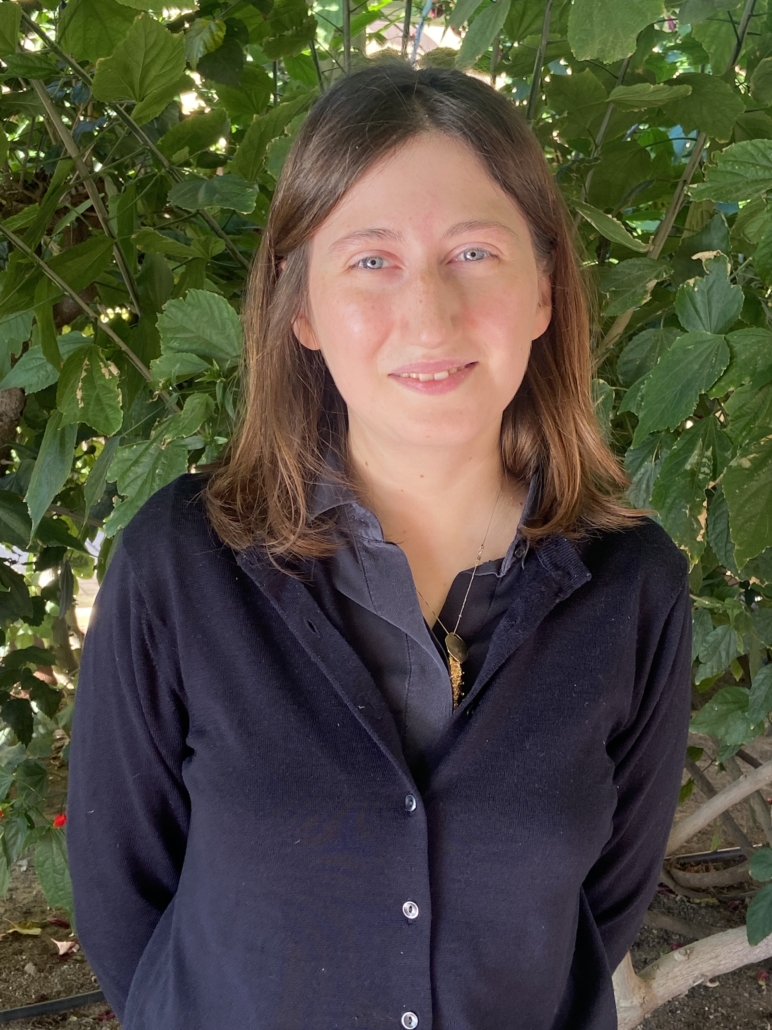
Maria Serena Matarrese at the Faculty of Philosophy and Arts (UMA)
Between 2 September and 2 December 2025, we had the pleasure of hosting at iArtHis_Lab (Department of History of Art, University of Málaga) Maria Serena Matarrese, D. candidate at the National Doctorate in Heritage Science (Sapienza Università di Roma / Università Cattolica del Sacro Cuore, Milan), on a research stay linked to the research lines of Complexhibit.
The stay was articulated, in the first place, as a process of immersion in the academic life of the Department, The programme is based on a regular meeting to discuss their doctoral project and, at the same time, identify areas of contact with our research: how to describe contemporary exhibition practices without reducing them to inventories of objects; how to formalise what happens “between” work, discourse, device and reception; and what it means to document the ephemeral when the ephemeral is precisely what is constitutive.
One of the contributions most directly aligned with Complexhibit was the development of a case-oriented methodology to describe contemporary exhibitions by means of ontology OntoExhibit, with a specific focus on Live In Your Head: When Attitudes Become Form (Kunsthalle Bern, 1969), curated by Harald Szeemann. The work, which is still in progress, is focusing on modelling curatorial concepts, artistic processes and documentary traces within a semantic web framework: not only “what was shown”, but also "what was shown". how it was articulated, What tensions it activated and what traces it left in texts, archives and memories.
Another decisive front was the discussion and refinement of the ontological strategies to represent procedural and immaterial works, The project is based on three issues that cut across the core of the project:
- temporality (what counts as an event, duration or iteration),
- documentation of creative and curatorial processes (not as a supplement, but as part of the phenomenon),
- y relationship between exhibitions, theoretical texts and archival materials (as interdependent ecologies of meaning).
Finally, Maria Serena expanded on her comparative research on digital memory practices in museums The Spanish context - until then developed on the Italian and British cases - through the design and discussion of a semi-structured interview and the selection of cases such as Museo Carmen Thyssen Málaga, MUCAC, Museo Reina Sofía and Fundación Juan March. This work opens up a particularly promising avenue for Complexhibit: connecting memory policies, archival strategies and institutional narratives with models capable of describing not only contents, but regimes of visibility and oblivion.
Beyond specific results, Maria Serena Matarrese's contribution can be summed up in something that we particularly value at Complexhibit: her ability to asking difficult questions without losing technical rigour, and to turn these questions into modelling decisions, debatable categories and testable prototypes.
We are deeply grateful for their commitment, their intellectual maturity and their collaborative generosity, and we are pleased that this stay has consolidated a common ground from which to continue working: thinking of the exhibition as a complex object, The project, made up of relations, temporalities, mediations and traces - and to provide us with the tools to describe it without impoverishing it.