DATA CULTURE: navigating the complexity of cultural systems
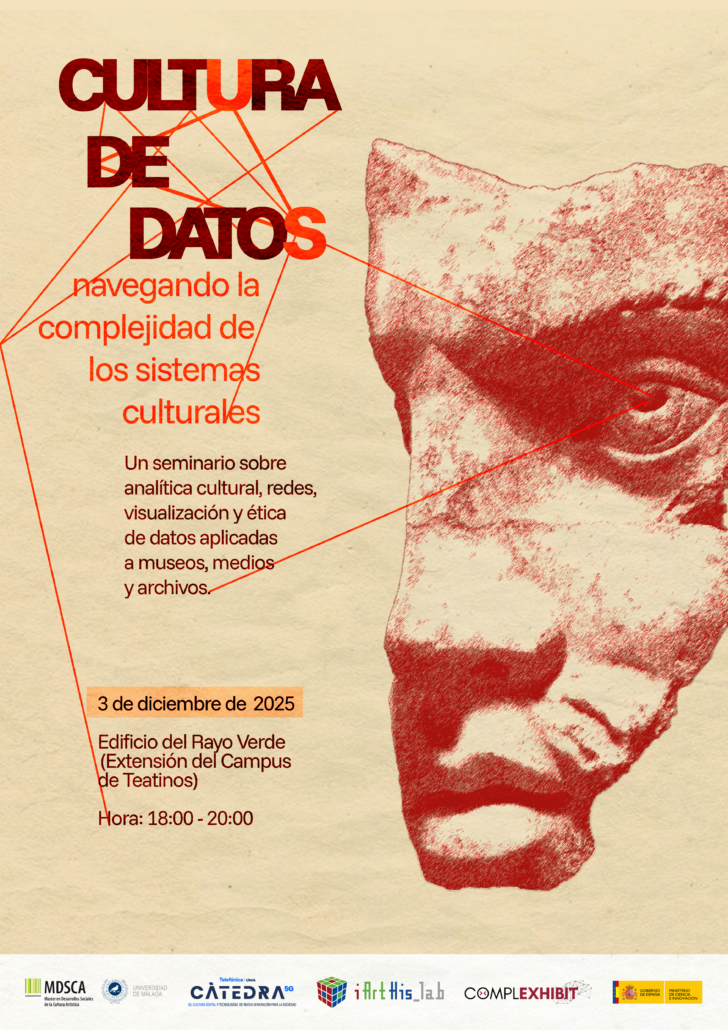
The next 3 December 2025, of 18:00 a 20:00, we will celebrate in the Edificio del Rayo Verde (Teatinos Campus Extension, University of Malaga) the seminar “Data culture: navigating the complexity of cultural systems”.”.
We will talk about cultural analytics, networks, visualisation and data ethics applied to museums, media and archives, and how these approaches allow us to rethink cultural institutions as complex systems.
Participants:
- Bárbara Romero Ferrón, Postdoctoral researcher at the Provenance Lab (Leuphana University).
- Maria Ortiz Tello, D. in Art History and MA in Digital Humanities.
- Ángel Lumbreras Fernández, Pre-doctoral researcher on contract at the University of Malaga.
Activity organised by the Master's Degree in Social Developments in Artistic Culture (MDSCA), the Telefónica-UMA Chair, iArtHis_Lab and the project Complexhibit.
📅 3 December 2025 📍 Green Lightning Building (Teatinos Campus Extension, UMA) ⏰ 18:00-20:00
#C DataCulture #AculturalAnalytics #HigitalHumanities #Museums #iArtHisLab #CUMATelephoneChair #Complexhibit
DESCRIPTION
The seminar «Data culture: navigating the complexity of cultural systems».» aims to provide cultural professionals and researchers with a critical and practical framework for working with data in museums, media and archives. Based on cultural analytics, network analysis and information visualisation, the course proposes understanding cultural institutions as complex systems in which works, audiences, infrastructures and decisions mediated by data circulate.
Specific objectives include:
-
Introduce the basics of cultural analyticsWhat data do museums, archives and media generate and manage today, and how can they become an object of research and a management tool?.
-
Exploring cultural networks (of works, artists, institutions, publics, discourses) and show how their representation through graphs allows us to detect patterns, hidden relationships and power dynamics.
-
Working with visualisations as ways of thinking: not just as “pretty pictures”, but as analytical tools that help to ask new questions about collections, content and audiences.
-
Opening a space for ethical reflection around the extraction, processing and circulation of cultural data: biases, algorithmic opacities, privacy, copyright and institutional responsibilities.
In the contemporary context of platform logics, recommendation algorithms and economies of care, this seminar is particularly relevant because it addresses the political and cultural dimension of dataWho decides what is measured, what is preserved, what is made visible and what is left out of representation. Working with data in culture is no longer just a technical issue, but a critical competence central to imagining more open, reflective and accountable institutions.
Finally, the course forms part of the project Complexhibit, to which it contributes in two ways. On the one hand, it offers a training space where methodologies and tools that feed the project's research on complex exhibition systems, knowledge graphs and semantic models are shared. On the other hand, it functions as a laboratory of ideas: the seminar's discussions and exercises allow Complexhibit's hypotheses on how to model, visualise and analyse exhibitions, collections and cultural networks to be tested, thus reinforcing the bridge between theoretical research, digital experimentation and curatorial practice.